dedicate this blog to fame in archeology Italy and the world.
How many famous people are passionate about archeology? How
archeology has characterized the history and the most recent costume?
Follow us and you will see great things!
Thanks and regards, the author
Archaeology
Christmas Night Light
year of Jesus 'birth (year zero of our era) and' was set at 754 'ab urbe seasoned' (ie since the founding of Rome) only in the sixth century by Dionysius the Little monaco growth (Dionysius Exiguus), based on a passage from the Gospel (written by Luke in greek not a contemporary of Christ), for which the Baptist had begun preaching in the sixteenth year of Tiberius, when Jesus was 30 years. It seems, according to other passages of the same Gospel of Luke and one, written in Aramaic, Matthew, a disciple of the Messiah, that Jesus was conceived and created before the death of Herod the Great, the historian Josephus in the fixed his "Jewish War" to 750 'ab urbe seasoned' and then that date should be moved back four anni.D 'Besides, still says Luke, however, that Mary had to go to Bethlehem for the census, when Quirinius was governor of Syria and then the date of birth Jesus should be moved forward to 6 / 7 anni.Betlemme itself as the birthplace of the Messiah, it seems unlikely. It is said that credit for the descent from David, as they wanted the prophetic texts (Micah 4:1). It 'more likely to be born in Nazareth, but then maybe fiIologicamente should be attributed to Jesus of Nazareth is not the epithet of the Nazarene, which would more properly belongs to the Nazarene sect of which we speak Epifanio.Quanto day of birth, Then, you can not say almost anything, as the Fathers of the Church itself had suggested, before the fourth century, various dates: January 6, March 28, 2, or April 19, May 29 and 18 and December 25 novembre.Il 'certificate from 335/336 (evidently it could formalize the date before the year 313, the year of the Edict of Constantine, which will open up the new Christian worship) and then 'found in 354 the Roman Chronograph, which proposed a list of martyrs ( Depositio Martyrum). Aureliano had previously wanted to dedicate this day to the worship of Mithra, the god of Iran, slayer of sacred bull, which was celebrated in caves and underground temples, with its procession of wise and well known magusei Piret (sacred fire lighters) . Even before the Romans had dedicated the Solstice INVEMA the "Dies Natalis Solis Invicti", that 'the Sun, a legend was born with a miraculous birth of the Virgin of heaven, queen of mondo.Il Sun-worship, however, has much more ancient expressions (Kheper, Atum, Ra and then the Egyptians at Aton, Baal in Baalbeck in Syria and also from the Babylonians, Assyrians, Persia etc.) Similarities of date or otherwise with earlier pagan religions, however, have more than one: the Egyptian god Osiris
had conceived the child in March Oro (Horas) and he was born December 25
for the Greeks Dionysus was born of a virgin at 25 December
same date for the virgin birth of Buddha
Scandinavians celebrate the birth of Freír, son of Odin and Frigga, the winter solstice
the Saturnalia were the days (from December 21 at year end) was celebrated in Rome in which Cronos (Saturn) , which was also spent the last month of the year. The same
December 25 and 'a wrong date. It was in fact considered the day of the winter solstice because of a delay accumulated for inaccuracies calendar giuliano.Anche December 13, because it seems the same type of error, this time in reverse, was identified as a solstice day (ie ' the shortest and the night and 'called' Night of Light "). Now that date is celebrated in Saint Lucia, the saint of light, as a martyr accecata.La distance, then, between the dates December 13 to 25 from December 25 to January 6, consists of 12 days (known as "Kalends" that apply to represent the beginning of the year, 12 months ahead (the Kalends omen). The stump or log, which is traditionally placed on the fire at Christmas, should continue to burn (it goes off in the morning and again every night) until the Epiphany, to be able to take good auspici.Il strain made by burning 'light and heat, the same gifts of the sun. And in the saga of our Middle Ages we find the dead trees, also called the Tree of Sole.Ed now we come to speak of the Christmas Tree, tree, gifts, that is the giver of abundance and every "good things" (in the same way Tree of Plenty), as a principle of generativity. The symbolism of Eden c'e'un tree in the middle of the world, the Cosmic Tree, the Axis of the World, a force that sustains and nourishes the universe, it puts in communication the various levels and symbol luminary maius, sole.L the 'World Tree was portrayed in medieval miniatures, with the roots pointing the sky, like the trees of Dante's Purgatory, as the tree Acvattha India. In parallel, in other mythologies, we find the tree of paradise Persian Haoma, PAC shaft of the Golden Fleece of the Argonauts, the tree of golden apples in the garden of the Hesperides, the New Testament etc.Nel puiítuale consideration and Edenic tree ' the tree of the Cross (the medieval legend of the Cross, the cross was built with the wood of the tree planted in the center of Eden). The choice of the tree as a symbol of Christmas goes back to a German legend Luther Martyrs. Not always apparent fir, but often also other trees like the oak tree (remember that sacred to Zeus at Dodona, or the * sacred to the Germans, who according to another legend, St. Boniface cut down in Geismar, then giving a hand to spruce), ilex , pine, cedar, cypress, ash (the ash Yggdrasil of the Edda Odin and 2), laurel (which Crete was called the Tree of the Sun), juniper (which would give shelter to the Holy Family fleeing to Egypt), holly, honeysuckle, the holly, mistletoe (the Celtic priests of Gaul, that the Druids, dressed in white, rose on an oak tree, the day of the solstice, as we faithfully described by Pliny the Elder, cut with a small crescent of gold to shake off a branch on a white linen), hawthorn, rosemary, Christmas rose, the rose of Jericho, the ivy. The distribution of gifts, especially children, not is carried out always and everywhere under the tree, but also with direct delivery to par. and Christ Child, or Santa Claus or its corresponding Russian Winter Grandpa or Grandfather Frost (Died Moroz). It 'is constantly at Christmas, Epiphany, but also (with the Three Kings or Epiphany, the "Old" burning or saw, to' throw away 'the previous year), New Year (Feast of the Circumcision Jesus and the feast of the Mother of Christ as well), San Silvestro, who instead used the day before, December 31 last day of the year, and 'a baptized Constantine, the emperor who Christianized the Roman Empire (the church of S. Silvestro in Rome was built on the area of \u200b\u200bthe temple of the sun Aureliano: another example of overlapping cults pagans). In some areas is carried out, however, the celebration of Saint Lucia (December 13) or St. Nicholas of Bari-San-Nicholas of Myra (recurring December 6) Santa Claus (St. Niklaus) for the Germans, and St. Nick for the Scandinavians or the most 'ancient progenitor of our modern Santa Claus every year starts from his home in Finland (Rovaniemi, Lapland) on a sled full of gifts drawn renne.Un reference to the Magi and their march, guided by the comet which has become visible in the constellation Leo, the symbol of Judea. In this star was referring, in the Old Testament (Numbers 24, 17) Balaam's prophecy, I guess called by Balak, king of Moab, who saw his kingdom threatened by Moses', it seems that they were aware of it. the priests of the Persian prophet of Iranian religion Zarathustra (Zoroaster). Of the Magi mentioned in the Gospel of Matthew, although not reveal the mystery of their kingship it 'the origin and did not even mention the number. It is believed that the term Magi is Magusei or instructions, then the scholars and priests of the Eastern religions. Later they were confused by the Babylonian priests (Middle East), the Chaldeans, dedicated to the study of the stars, hence the identification with diviners, necromancers, wizards. The largest number in the certificate and sources ', as you know, three and three are also those represented in the most' ancient painting preserved: that of the third century the Greek chapel in the catacombs of Priscilla in Rome. What were the King and then 'and equally uncertain as to their names will appear different in various documents, all though quite late (VI IX century). The medieval legend of the golden Jacopo da Voragine (Varazze) (ca. 1230 -1298) it bears the names of Greek, Hebrew and Latin: all well differentiated between loro.I gifts traditionally have certainly gone a symbolic meaning: in fact, gold and 'sign of royalty', the incense of the divine nature of Christ's mission and myrrh his fate mortale.Rimane to say something more of the Nativity, the Magi of which are inevitable extras. The first crib (living) seems to have been the one represented in Greccio (near Rieti) from St. Francis of Assisi, the Christmas of 1223, according to his chronicler says Thomas of Celano (1190 -1260). Perhaps not everyone knows, however, that the Roman basilica of Santa Maria Maggiore, which was celebrated by Honorius VI the first Mass of Christmas, and 'also known as Santa Maria ad Praesepe', as it contains relics of the Holy Crib (ie 'boards of the manger in Bethlehem). The construction of cribs has often reached in. Over the centuries, high levels of artistic expression. Some important examples, among many retained therein, can also be seen at the Museum of the Nativity in Brembo di Dalmine.
FULVIO SCALABRINI (from www.gruppoarcheologicobergamasco.org )
The "Sistine Chapel" of the Maya
Aristide Malnati
A room painted in bright colors and intense, with the depicted scenes of the major myths and the basis of the vast pantheon of deities Mayan, identified by American archaeologists in the region of El Peten, Guatemala's nord.Una once we depart from the usual survey of Mediterranean civilization, seeking to follow and submit the findings of greater weight, and we venture exploration of the Mayan civilization, which flourished in the area remote and peripheral to the classics. Needless to say, does not seem like the Mayan civilization, historically manifested itself in Central America, has its origins far back in time: the first settlements can be placed around 1500 a. C., although it is only around 300 A. C., the transition would happen in a real social structure urbanizzata.Con cities, similar to cittàstato, remember that both the "poleis" Greek, has spread a uniform culture throughout the Maya centers fully and harmonious development, such as Tikal, Copan, Palenque and Bonampak, was flourishing until around to '800-900, when foreign powers in the region destabilized Maya centers and starts the inexorable decline. Here is a first milestone, a small revolution, as practiced by a recent archaeological discovery, which concerns Cancuen, most of the time Maya center.
"The excellent condition of the paintings shows that the ancient Maya had reached a high degree of sophistication and elegance long before the classical period of their civilization, which dates from the seventh century AD." William Saturno, University of New Hampshire
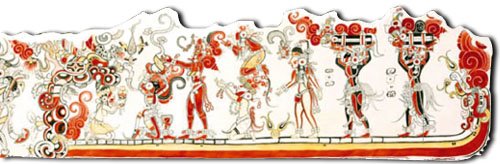
San Bortolo - The design of the Great Wall and one of its details in the picture
"We are the authors of a small renovation in the field of pre-Columbian studies! We can say with good certainty: the Maya did not disappear with the arrival of the conquistadors English, but at the end of a long process of decay, which was triggered by an act of violence occurred around 800 AD C. and we found the archaeological evidence '. It is peremptory in its conclusions Demarest. Archaeologists digging in the last year, concluded recently, they came across the remains crucial event for the decline of the Maya: the destruction of the town of Cancuen, at the time the most flourishing of the whole kingdom thanks to strong trade with the 'entire Mesoamerican region, ritual and performance of 50 elders of the royal court, there risiedeva.Ma that's not all: the enemy "invisible" not only wiped out the entire royal dynasty, but destroyed symbols of religion and political power (statues, monuments), effectively led to the impossibility of recovery at any level. The team of American researchers, which employs Guatemalan archeologists and scholars under the French Archaeological Institute in Mexico City, has unearthed the skeletons, perfectly preserved by the mud abundant in the tropical jungle of hundreds of people between minimum of 31 nobles, thrown into the water tank, another dozen in a mass grave near the royal palace and - remarkable discovery - the bodies of the sovereign Kan Maax and his wife the queen, without regard thrown in a shallow grave nearby. The Cancuen residents were well aware of the danger of the attack on their community, as revealed by the trenches dug in a hurry and wooden palisades and stone erected at the last moment and have not been completed, desperate attempt of a defense, which was in vain. Such bastions allow then to understand that the Maya were attacked in the heart of their political power from an external enemy, probably residing in the highlands of modern Mexico: "There probably will say something the remains of weapons such as arrows, spears, axes, used in the battle, which suggest an initial analysis progressed to a nation of warriors, "noted Demarest. The reasons for the collapse of the Maya civilization that flourished for more 1500 years in Central America, were investigated by generations of Americans and gave rise to a disparate jumble of interpretations: droughts, earthquakes, plagues, wars or sanguinose.Sono however, all agreed to assume a slow and inexorable consumatosi collapse within a few centuries and brought to fruition by the arrival of the Spaniards. In any case it seems certain, in light of recent discoveries, the process was triggered by the attack on bloody Cancuen, which was set as a snapshot in time, still perfectly readable from the eyes of archaeologists.
"It's as if some future archaeologists who have known only the works of modern art discovered one day the paintings of Michelangelo and Leonardo Da Vinci, including the Sistine Chapel in St. Peter. "William Saturno, University of New Hampshire
And, if archaeologists from different backgrounds solve one of the biggest mysteries related to the Maya, other scholars are not less archaeological evidence and identify important elements of everyday life in that distant people. It 'was discovered the oldest football field maya: 25 centuries ago and, as announced, the archaeologist Fernando Acevedo, was found during the construction work to build houses near the city of Merida in the state of Yucatan.Realizzato exactly five centuries before Christ, is long and 25 meters wide and 4.5 together with other findings occurred in the same area, will in part of "rewriting the history of the Maya," because no one knew there were facilities in the region northwest of Yucatan.Per this civilization, as in other Mesoamerican cultures, the game of football fulfills a funzionerituale, and its camp was built within the precincts ceremonial since at least 3500 years ago. The game was the explanation of the creation of the sun and moon, which occurred after a game between the gods and Hunahpu Ixbalanqué Sottomondo.Ma against the lords of the most striking example is the recent discovery of a room painted in bright colors and intense, with the depicted scenes of the major myths and deities of Mayan basis of the vast pantheon: a sort of "Sistine Chapel", identified by American archaeologists in the region of El Peten in northern Guatemala. It is multicolored murals (nine meters long and one meter in height) dating back to the first century before Cristo.Abbondano yellows, oranges, blues, grays and reds. The murals, which represent the history of creation and the kingdom of the Maya, have centered on the scene of the coronation of the god of corn and are the oldest known wall paintings of ancient Central American civilization, just the result of the classical period murals are located on the inner walls of the pyramids of the site: "I am a masterpiece" according to William Saturno, a professor at the University of New Hampshire and project director, who has compared them to the paintings of Leonardo da Vinci and Michelangelo. Scholars are still debating the role that would have decorated the room in the Mayan culture and Saturn has suggested that it might be a room where the king was the dress rehearsal of his public performances.
the site of the findings, called San Bartolo, had been discovered four years ago, some paintings and the oldest known royal tomb Central finora.Ulteriori radiocarbon tests on the paintings have subsequently revealed that the central part of the mural was 200 years older than what had been said at first and in a state of perfect preservation, to the point that, according to archaeologist "Seemed to have been painted the day before." To explain the exceptional nature of the discovery of the New Hampshire student added: "It's as if some future archaeologists who have known only the works of modern art one day discover the paintings of Michelangelo and Leonardo Da Vinci, including the Sistine Chapel in St. Peter. "The room with the drawings, which relate to mystical themes, revolutionize, according to the discoverer, everything we think we know so far about the beginnings of pre-Columbian civilization, also the ' importance is, as anticipated, that the frescoes, which extended the four walls of the room - only two of which were still standing at the time of discovery -, Inspired by Mayan mythology about creation, with the four gods representing water, earth, sky and paradise. At the center there are instead two coronation scenes, one depicting the god of harvests, the other a true king. "The excellent condition of the paintings - said Saturn - shows that the ancient Maya had reached a high degree of sophistication and elegance long before the classical period of their civilization, which dates from the seventh century AD". The wall found then provides definitive evidence that the Maya, known for the advances in astronomy and mathematics, using the same rite of coronation for more than 800 real anni.Infine the Maya and women: the importance of the feminine in a society seemingly maschilista.Niente more wrong! to reveal yet another recent discovery of a culture, than ever in recent times has shown extraordinary and enriching surprises. University of Calgary archaeologist and her international team of researchers has discovered the first known portrait of a woman carved in stone, showing precisely the fact that women held positions of authority at the beginning of Maya history, as queens and deities.
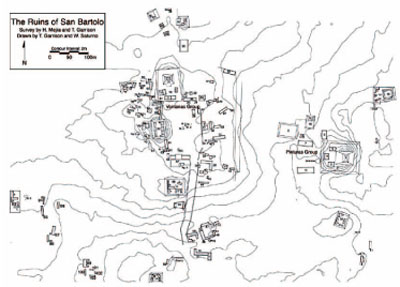
Archaeological Site map San Bartolo
The discovery was made earlier this year in Guatemala at the site of Naachtun, a city located about 90 km in the dense jungle north of the famous center of Tikal. The woman's face - carved on a stele dating to the fourth century AD in an artistic style never seen - also suggests that women had a central role in politics and public administration. The woman may in fact be a historical figure, although Kathryn Reese-Taylor, director and author of the discovery team, suggests that it may consist of a mythical figure. There are few to be convinced by such a hypothesis: hieroglyphic inscriptions of the Late Classic Period (600-900 AD) mention female deities, but none had ever been discovered on a stele. "When hieroglyphic texts mention women are always the wives or mothers of some male character, say the experts and think of a real character. The stela measures two meters, a width and 50 cm depth was buried by their manufacturers in an ancient building, after the city was attacked and the inscriptions erased by enemy forces. The burial was a reverential act meant to honor the individual whose image was engraved on the monument and, in this case, the sculptural group was completed by the image of an infant, which allows the more reason to think that we are in the presence of characters storici.Ne are certain in many people, including Julia Guernsey, a professor of Pre-Columbian Art History at the University of Texas at Austin, said. "If this individual is, as everything leads to believe a historical woman, it means that his portrait of prey over one hundred years on other representations of powerful women in the stele in the Maya lowlands Period Classico.Significa the need to reassess the role and status of women within the dynamics of the First Classic Period. "" The other fascinating aspect of the image is its formal representation, or style. The fact that the body of the figure is completely absent and attention focused on the head and headdress is very interesting and unusual, "says the American scholar.
Aristide Malnati (from http://www.leadershipmedica.com/ )
Agatha Christie passionate about archeology?
We had learned by reading, for example, Death on the Nile, but it was possible to discover the details of this passion by visiting the exhibition "Agatha Christie and the Orient: criminology and Archaeology", organized in various cities in Europe in 2000. The English writer accompanied her husband for years archaeologist, Sir Max Mallowan, in his excavations in Iraq and Syria, helped him in his work of cataloging and preservation of artifacts and photography. The exhibition presented findings excavated by Mallowan, unpublished photographs, first editions of books, memorabilia of various types and a brand new color film, shot by the same Christie's in 1938 during excavations at Tell Brak.
by www.librialice.it
ARCHAEOLOGY AND LAURA BIAGIOTTI
My relationship with art starts from childhood, I remember the love of beauty that I He taught my father Joseph. The love of the arts (Rome is the cradle for thousands of years) I have been instilled since childhood: my father, who was fond of music, architecture, painting, shooting in the beautiful little populated city of the '50s with the joy of his eyes and steal your heart with so much beauty and an ambiance certain metaphysics of war. Then I started very young to travel to Italy and the world. But in those early years I took with me intact curiosity and thirst for culture and beauty. The love for beautiful things that they taught me also refers to the nature and above all, in his performances continued and ever divenire.Finito grammar school I enrolled in the Faculty of Arts and was majoring in archeology Christian, when I found "captured "the work of my mother Delia, who had a tailoring of high fashion. I owe my job to the teachings and the love of my mother and I especially the religion of her work in fulfillment of commitments and people who participate in our businesses. I had to take a drastic decision to twenty years and finally settling in the study of early Christian catacombs and the passion for moda.Resta still a trace of these studies on my way to work: the search for love, patience, mental attitude to the study phenomenon of fashion as a primary expression of human behavior.
by www.argoeditore.net
src="http://pagead2.googlesyndication.com/pagead/show_ads.js"> 

0 comments:
Post a Comment